THE JONATHAN MURRAY COLLECTION / DIRKS
Ref 46. 78th Highland (Ross-shire Buffs)
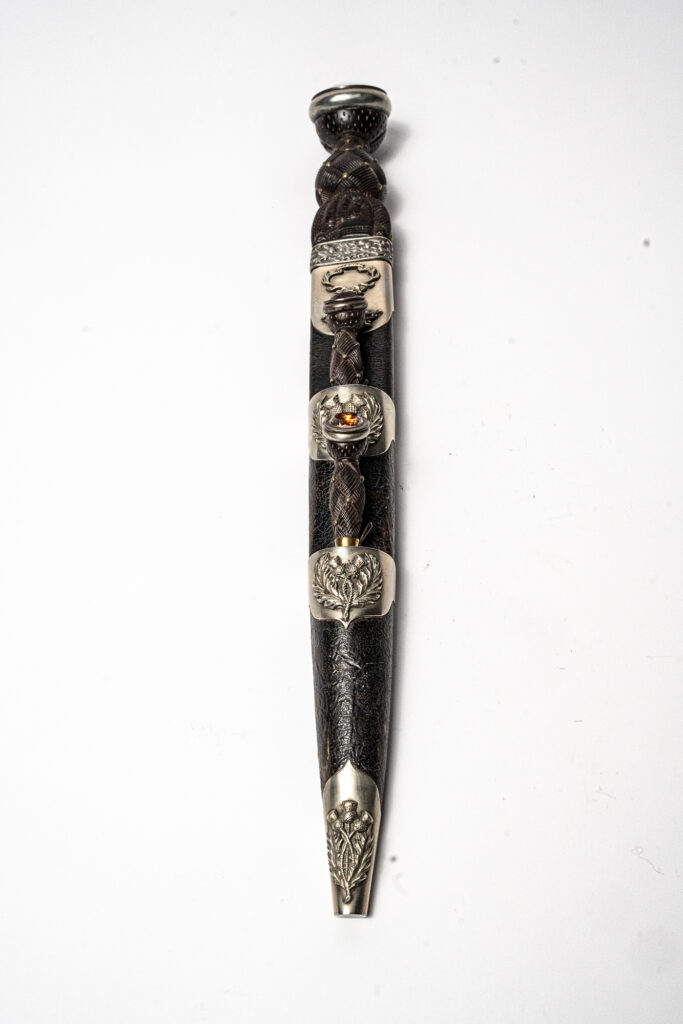
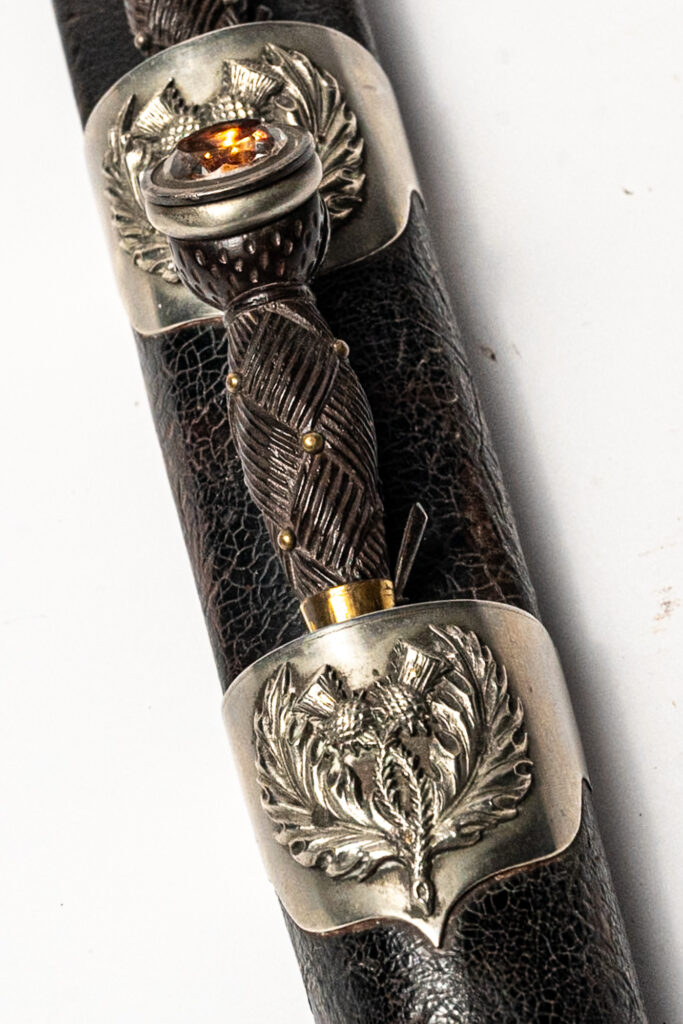
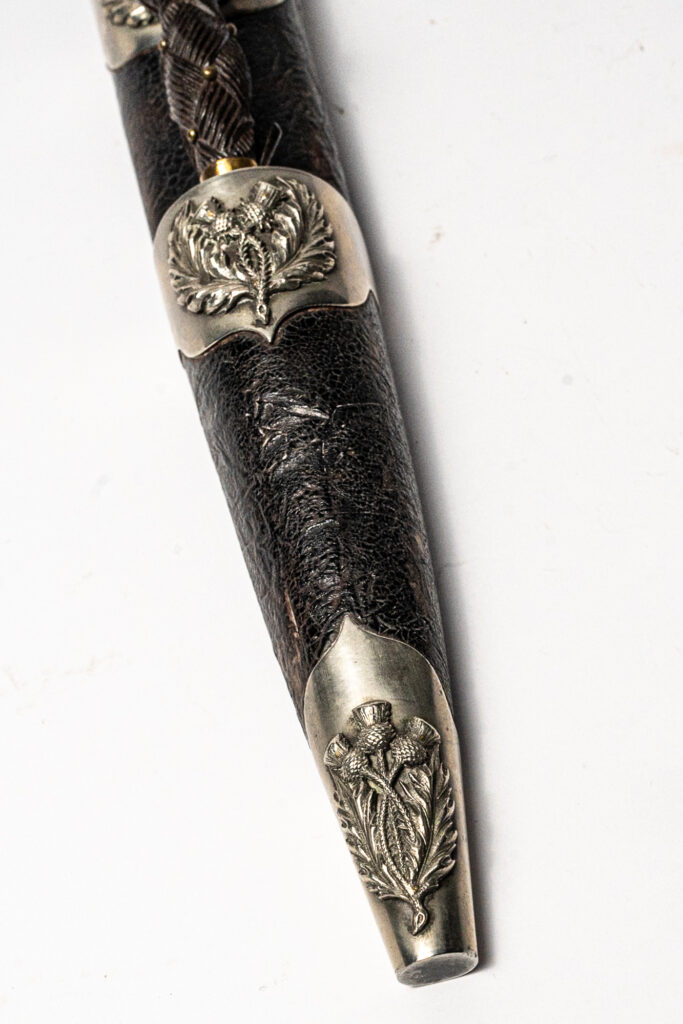
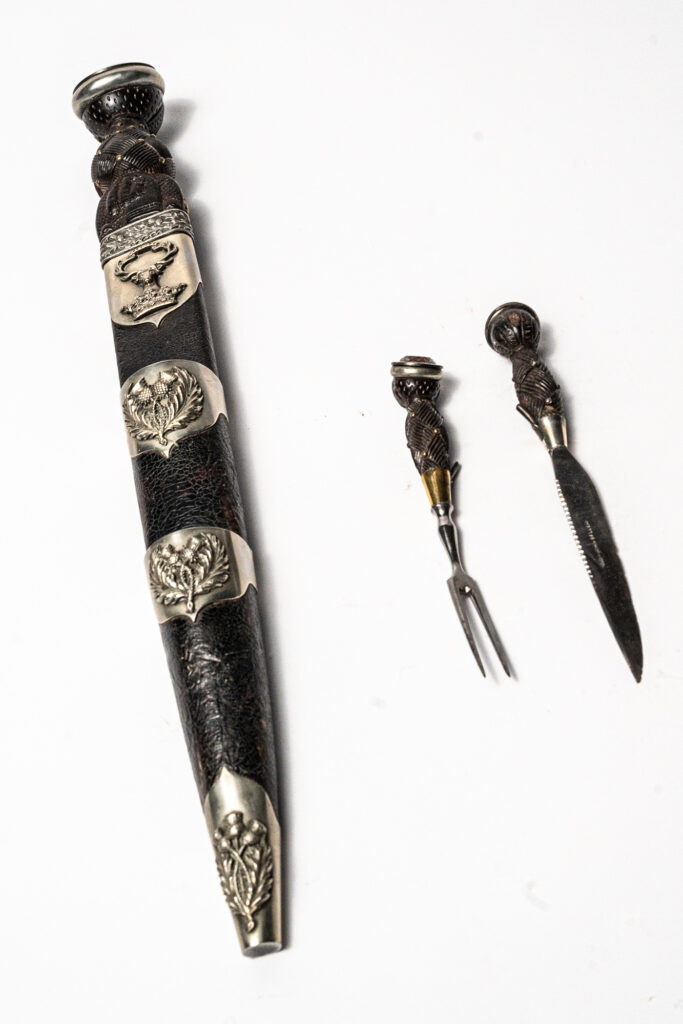
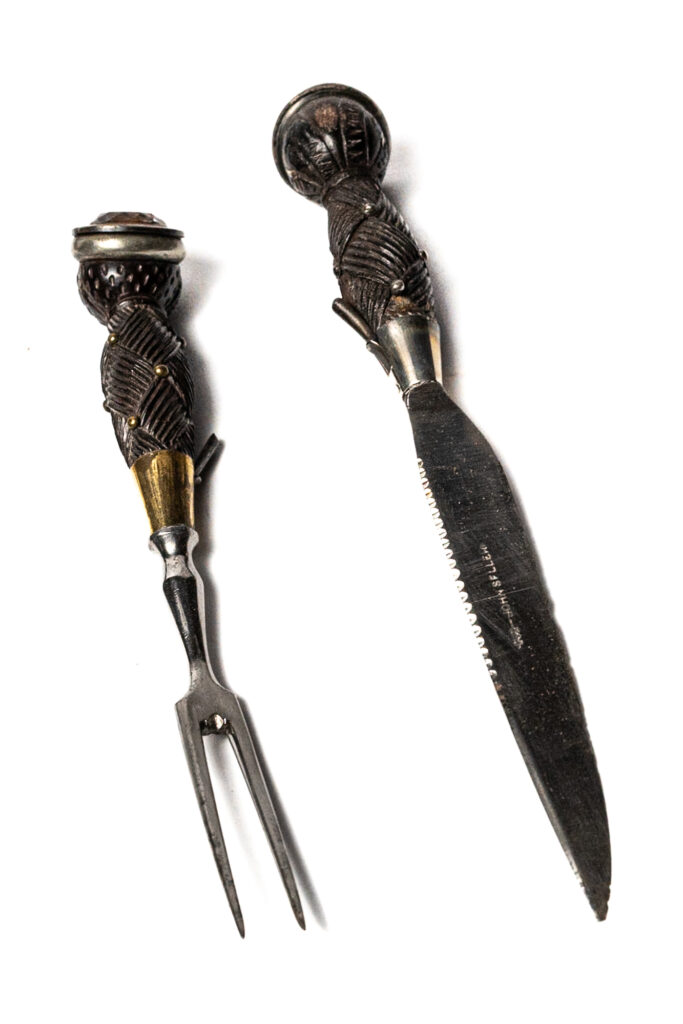
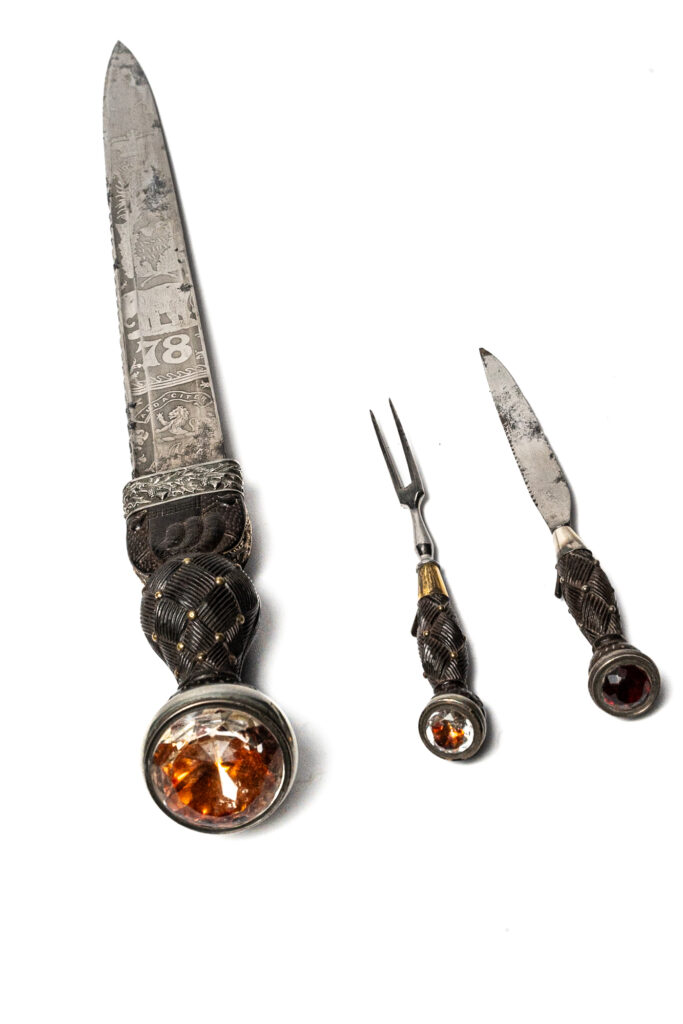
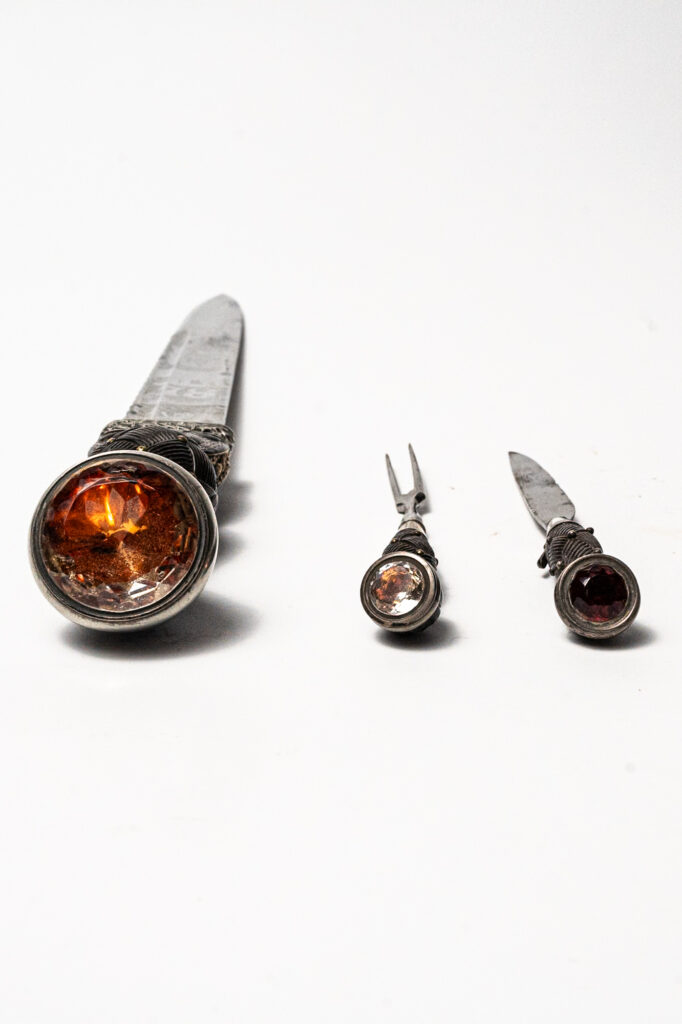
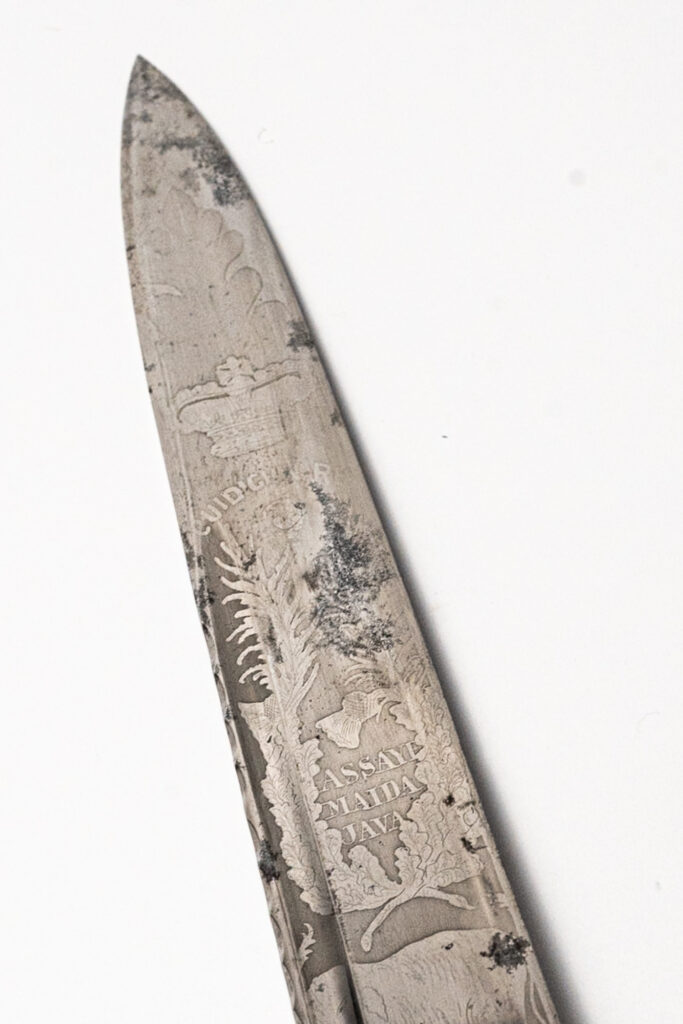
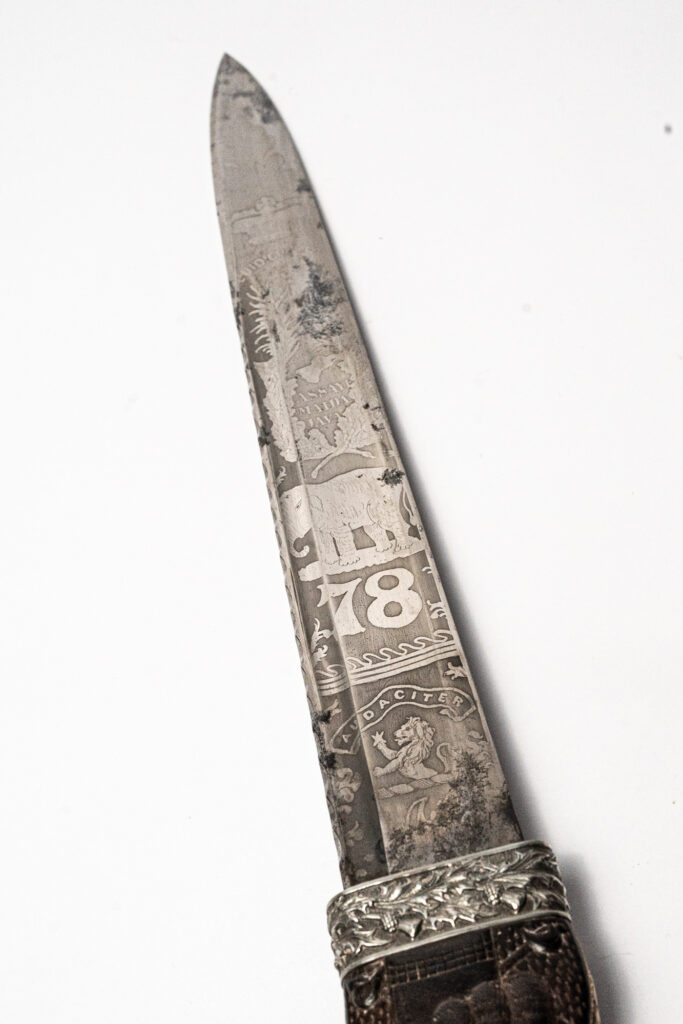
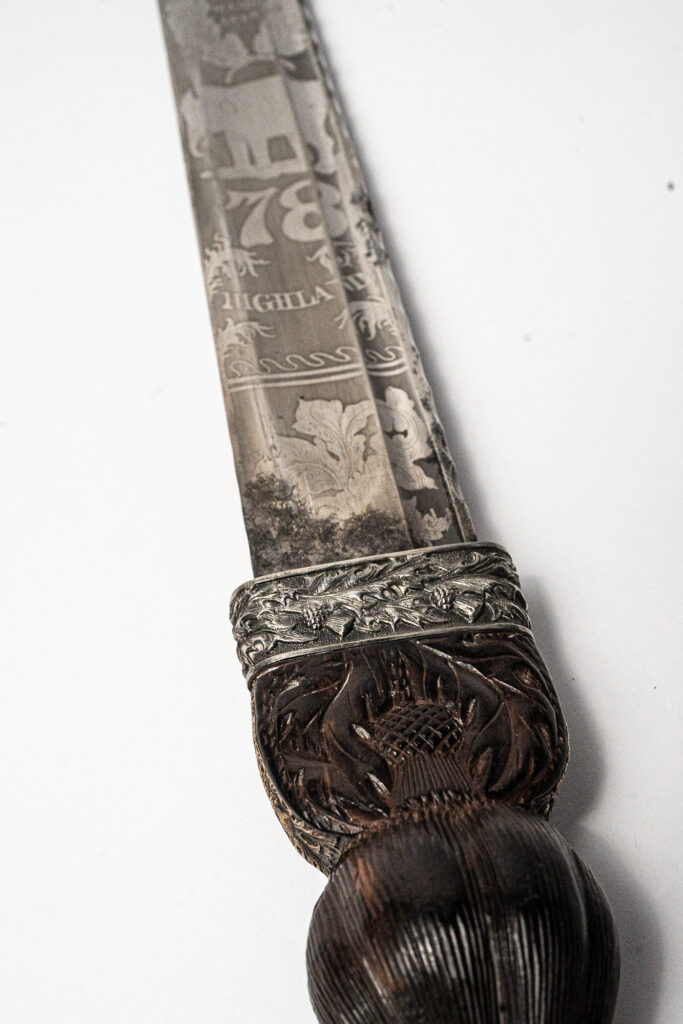
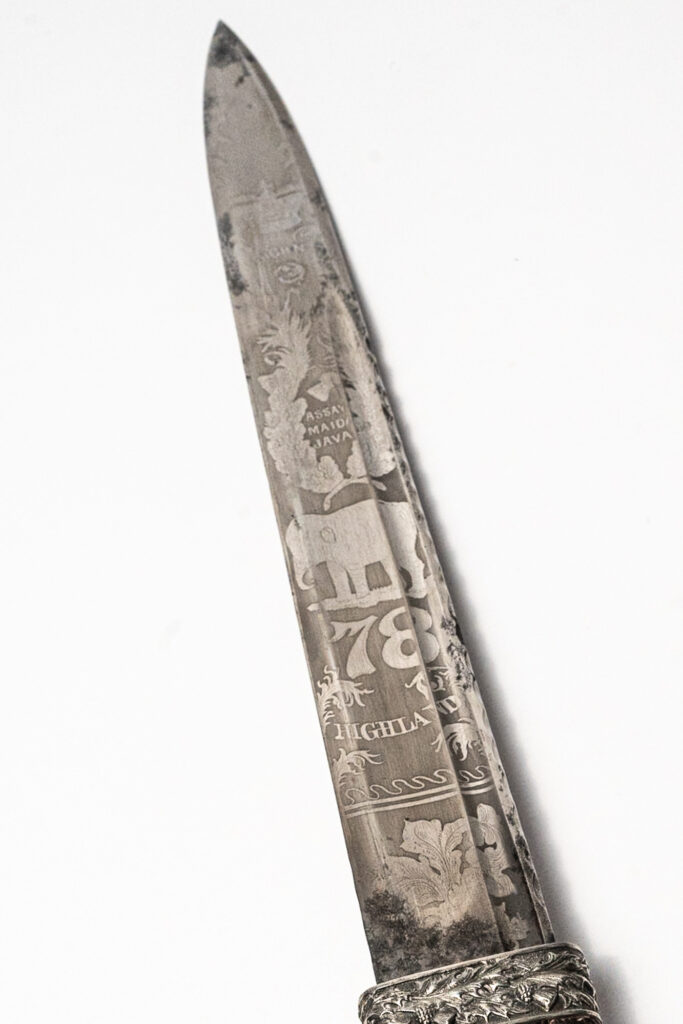
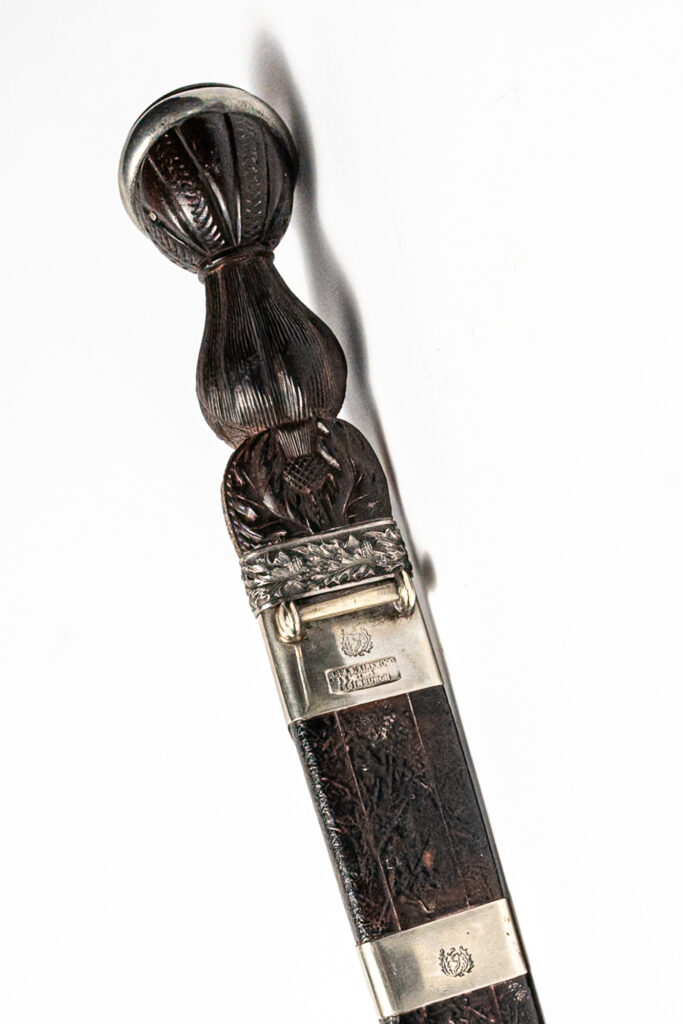
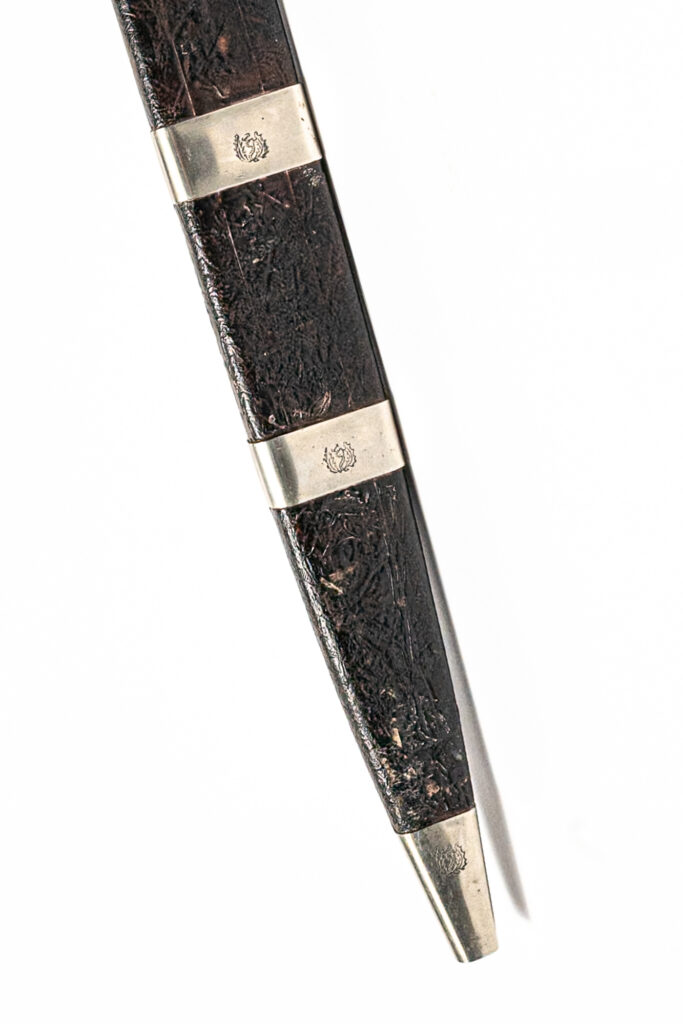
Officer’s dirk to the 78th Highlanders (Ross-shire Buffs). (Note that the blade is atributed to the 78th but the scabbard to The Gordon Hoghlanders – see explanation below.) White metal mounted dirk. Double fuller and faceted back edge, the blade etched on one side with Queen Victoria’s crown, CUIDICH’N RIGH, three battle honours; Assaye, Maida, Java, the Elephant, ’78’ HIGHLAND. On the other side of the blade etchings of Queen Victoria’s crown, CUIDICH’N RIGH, three battle honoyrs; Assaye, Maida, Java, the Elephant, ’78’, owner’s motto Lion holding a star) and creed AUDACITER eith owner’s inital (undecipherable). Wooden hilt carved with basket weave and set with brass studs. Engraved on the rear of the top mount R.& H.B. Kirkwood/66 & 68 Thistle St.,/Edinburgh. Pommel set with cut glass and contained with its leather covered scabbard and white metal mounts embossed with the regimental devices of the stag and Bydand and thistles. Matching knife and fork mounted ensuite. Dirk: 46cm. Blade: 31cm. Condition: Generally good. Some wear to plated parts. Foil backing on stone gone and all are of different shades. Blade with some rust and pitting. Bi-knife with rust and tip loss. Fork does not go all the way into the scabbard and has a brass mount possible for another dirk.
AUDACITER and the Lion holding a star is the crest badge of Ewing of Craigtoun and Keppoch (linked to Clan Ewing) is described as a demi-lion rampant with a star in its dexter (or right) paw.
The last battle honour on the dirk is that of Java which took place in 1811. The next battle honour to the regiment, which does not appear on the dirk is that of The Battle of Khushab (Khoosh-Ab) which took place on 7 February 1857 and was the largest single engagement of the Anglo-Persian War. Since this battle is not on the blade, the age of the dirk is estimated at between 1806 and 1881. The 1st Battalion gained the battle honour for Java in 1811. The 2nd Battalion gained the battle honour for Maida in 1806.
Bonhams Edinburgh confirm that the scabbard and the dirk are associated. However, the dirk has the particualrity of displaying mottos from two different regiments. Firstly, the Gordon Highalnders given the the Bydand motto above the Stag head on the top mount, Bydand being the motto of to the Gordon Highlanders. Secondly, the 78th (then Seaforths) as evidenced by the etchings on the blade. It would seem that the only offical link between the two would be as of 1994 when The Highlanders (Seaforth, Gordons and Camerons) were amalgamated with the Gordon Highlanders. Bonhams (Kenneth Staples) and I believe that this dirk may have passed down through a family of soldiers (Clan Ewing) from the first officer serving with the 2nd Battalion of the Seaforths (ex 78th) and the last officer serving with the Gordon Highlands serving at around the same period. Indeed, the maker R.& H.B. Kirkwood of 66 & 68 Thistle St., Edinburgh was in operation between 1872 and 1915. So the first officer served with the 78th up to 1881 but perhaps did not have a dirk. A dirk was then made by a relative officer (from Clan Ewing?) serving with the Gordon Highlanders around 1881 who wanted to capture the war efforts of his relative . The feather bonnet on the hilt is also trypical of the Seaforths, again linked to the 78th yet the baluster form, usually extreme for the Gordon Highlanders (i.e. horizontal) is replaced by a slatend balluster. The dirk could come from period 1872 to 1881.
Review from Lyon & Turnball – Colin Fraser : ‘A 78th blade and a later Gordon’s scabbard is odd. Best case scenario as you suggest a family blade used by more than on generation in different regiments. Otherwise a scabbard which has been made (or very luckily) fitted a dirk without one. I assume the officers rolls for the 78th would yield a name connected to the crest and if it went father to son perhaps the Gordon’s might reveal an officer of the same name…’
Period: 1806 – 1881
Category: Dirks
REGIMENTAL HERITAGE
Brief History
Names of regiment through the year:
- 1793 – 1794: The 78th Highland Regiment. Formed 1793 by Francis Humberston Mackenzie, chief of the clan Mackenzie and a descendent of the earls of Seaforth, following the outbreak of the French Revolutionary Wars (1793-1802). Unusually, it was a two-battalion unit from its inception.The 2nd Battalion was formed in 1804 ans its only foreign posting was to the Cape of Good Hope, where it helped capture Cape Town from the Dutch in 1795, before being merged into 1st Battalion the following year. The 1st Battalion fought in the Netherlands (1794) and at Quiberon in Brittany (1795). It arrived in India for the first time in 1797, where it served in the Second Maratha War (1803-06), seeing action at Ahmednuggar (1803), Assaye (1803) and Gawilghur (1803).
- 1794 – 1881: Ross-shire Buffs
- 1881 – 1961: The Seaforth Highlanders (Ross-shire Buffs, The Duke of Albany’s) upon amalgamation with the 72nd Regiment, Duke of Albany’s Own Highlanders follwing the Childers Reforms. The old 78th became the 2nd Battalion. The old 72nd became the 1st Battalion.
- 1961 – 1994: The Queen’s Own Highlanders (Seaforth and Camerons) upon amalgamation with the Queen’s Own Cameron Highlanders
- 1994 – 2004: The Highlanders (Seaforth, Gordons and Camerons) upon amalgamation with the Gordon Highlanders
- 2004 – Present: Royal Regiment of Scotland upon amalgamation with the Royal Scots Borderers, the Black Watch, the Royal Highland Fusiliers (Princess Margaret’s Own Glasgow and Ayrshire Regiment) and the Argyll and Sutherland Highlanders
Battle honours:
- Second Anglo-Maratha War: Assaye
- Napoleonic Wars: Maida, Java
- Anglo–Persian War: Persia, Koosh-Ab
- Indian Rebellion of 1857: Lucknow
- Second Anglo-Afghan War: Afghanistan. 1879-80
Note of explanation
Bonhams Edinburgh confirm that the scabbard and the dirk are associated. However, the dirk has the particualrity of displaying mottos from two different regiments.
Firstly, the Gordon Highalnders given the Bydand motto above the Stag head on the top mount, Bydand being the motto of to the Gordon Highlanders.
Secondly, the 78th (then Seaforths) as evidenced by the etchings on the blade. It would seem that the only offical link between the two regiments would be as of 1994 when The Highlanders (Seaforth, Gordons and Camerons) were amalgamated with the Gordon Highlanders.
Bonhams (Kenneth Staples) and I believe that this dirk may have passed down through a family of soldiers (Clan Ewing) from the first officer serving with the 2nd Battalion of the Seaforths (ex 78th) and the last officer serving with the Gordon Highlands serving at around the same period. Indeed, the maker R.& H.B. Kirkwood of 66 & 68 Thistle St., Edinburgh was in operation between 1872 and 1915. So the first officer served with the 78th up to 1881 but perhaps did not have a dirk. A dirk was then made by a relative officer (from Clan Ewing?) serving with the Gordon Highlanders around 1881 who wanted to capture the war efforts of his relative. The feather bonnet on the hilt is also trypical of the Seaforths, again linked to the 78th yet the baluster form, usually extreme for the Gordon Highlanders (i.e. horizontal) is replaced by a slatend balluster. The dirk could come from period 1872 to 1881.
Review from Lyon & Turnball – Colin Fraser : ‘A 78th blade and a later Gordon’s scabbard is odd. Best case scenario is a family blade used by more than on generation in different regiments. Otherwise a scabbard which has been made (or very luckily) fitted a dirk without one. I assume the officers rolls for the 78th would yield a name connected to the crest and if it went father to son perhaps the Gordon’s might reveal an officer of the same name…’